Friday, March 11, 2011

I know I mentioned that I was going to share my wisdom on polar bears this week, but there have been a couple of developments in the world of sled dogs that I would rather share. I’ll save polar bears for another time.

I have a new roommate! He is a native of Nunavut, tall, broad and handsome, and even though he is only 11 his hair is almost completely white! When he gets really excited he dances around the kitchen and makes sounds that I have decided sound just like a wookie. Meet Toko…


This obviously isn't my picture, he just arrived and I can guarantee there is no green grass or bushes here, this time of year or any other for that matter! I didn't have a picture of Toko to post so on a whim I googled "Toko sled dog" and found a blog post that Siu-Ling's mom wrote about Toko! http://homepage.mac.com/puggiq/V12N2/V12,N2RetiredSledDog.html

Toko is a retired sled dog from my roommate’s team. He was once the biggest and most dominant male on the team, but in 2009 he threw in the towel at the age of nine, quite literally by his own decision. Siu-Ling was on a two month voyage from Iqaluit to Pond Inlet (three quarters of the length of Baffin Island), and one morning after camping outside of Clyde River, Toko just got up and started to walk into town while they were getting ready to head out. Siu-Ling had to chase him into town and leave him with a friend. She flew him home once she returned to Iqaluit herself. Since then he has been living in Ottawa with Siu-Ling’s parents, and just returned to Iqaluit last week until Siu-Ling can fine a more permanent home for him. He is lovely, such a big sook. Siu-Ling can’t get over the transformation in him from being a big tough sled dog to a house-trained, playful sook!

I just love the family dynamics with the dogs. Toko is the father of four of Siu-Ling’s current sled dogs, including Tua, who is the mother of Giller and Gigi, who is the mother of the two puppies, Bo and Shubert (who are not very puppy like anymore – they are huge!). That makes Toko the great-grandfather of the team! Surprisingly though, he isn’t really interested in the team; he didn’t even want to get out of the truck when Siu-Ling took him down for a visit. I think he was probably afraid that she was going to chain him back up with the working dogs – he clearly has no interest in giving up his new-found cushy lifestyle as a house dog.

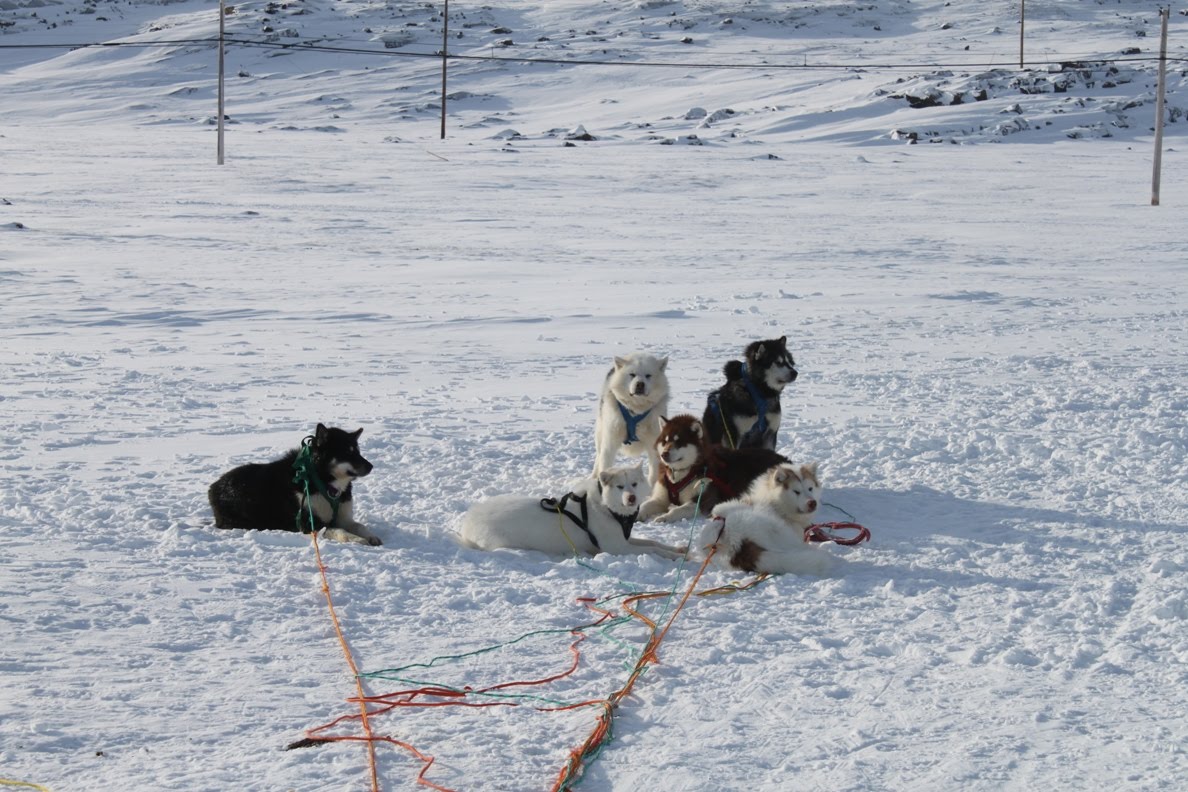
That is my first exciting sled dog news. The other, even more exciting sled dog news is I finally got to go sledding over the weekend! Siu-Ling’s regular sledding partner wasn’t able to go out on Sunday, so she asked me if I wanted to go – I was nodding my head vigorously before she even finished asking me. We headed out shortly after lunch on Sunday. There is so much energy while you are getting the dogs ready to go out; it is also the time when fights or other issues are most likely to occur. It’s very exciting, but also somewhat stressful.

The initial take off requires a lot of discipline, and it is clear that the dogs respect Siu-Ling. Once we finally got them all harnessed up and ready to go, things happened quickly. I was already on the sled and Siu-Ling basically hopped on and off we went. The first few moments were so thrilling! It was one of those moments when you can feel a big goofy grin on your face that you couldn’t erase if you wanted to. Things move fastest at the beginning and then over time the dogs get into a rhythm and the pace slows down. Unlike western arctic (Alaskan) huskies, Nunavut huskies have been breed for endurance in place of speed. They are thick and strong with big wide heads on their shoulders.

We passed a couple of other teams on our way through Sylvia Grinnell Provincial Park, which I hiked extensively in the summer. Then we passed over the Sylvia Grinnell River, where I did all of my fishing last summer. It was exciting for me to be on the other side of the river on fresh unexplored turf, though to be honest everything kind of looks the same under a blanket of snow and ice. It was a beautiful, albeit cold day and we passed several stunning views of inner Frobisher Bay - the pictures just don’t do it justice.

Lewis is the lead sled dog. After spending a few hours out on the trails I gained a new respect for big, goofy, stinky Lewis. I didn’t realize how much of the team’s direction is determined through voice commands. Siu-Ling would yell out a command to go left or right (“woi” to go right, and unfortunately I can’t remember the command for left!), and Lewis would veer in that direction, not always on the first try, but he would get there eventually. Siu-Ling lost a seal skin mitten during a mishap where Tua’s line wrapped around her leg during a kerfuffle (wow, kerfuffle is an actual word – I didn’t get spell checked!), and she was dragged alongside the sled just screaming. I was really worried that her leg would be injured, but once we got the sled stopped (which isn’t always easy) and the line untangled, she was fine – dogs can be so dramatic! So Siu-Ling lost her mitten and decided to go back for it. I was expecting a big wide turn, but was amazed how tightly she could turn the team, the sled barely moved from one spot until we were pointed in the opposite direction!

For the most part you are just sitting or kneeling on the sled, so it can get cold. To warm up a little and make things a little easier on the dogs, Siu-Ling encourages people to run up hills when they come along. I did my best, but it is difficult to go from a sitting position with poor circulation and cold muscles, to running up hill in snow wearing clunky winter boots fast enough to keep up with the sled (which to be truthful isn’t going very fast at this point). Just getting on and off the moving sled was difficult enough for me and at one point I stepped off the sled only to fall face first into a snow bank! It was a soft landing, so I was fine, but then I had to run extra fast to catch up. I didn’t try that again, so my feet got pretty cold. I wish I had remembered by boot warmers!

I was delightfully tired and not so delightfully cold when we returned back to the dog yard. Altogether it was an amazing experience, one that I am so thankful to have had before I get any bigger! I don’t think that would have been an option for me in another month, so the timing was perfect. Now I will be able to tell my baby that we went dog sledding when they were only -5 months old!


Wednesday, March 2, 2011

Eight months and counting….

Monday marked the eight month mark of my stay in Iqaluit. Eight months! I could hardly believe that when I realized it over the weekend. It’s funny how time can seem to move so slowly at times, but at the end of it all it seems to have gone by so fast. And the older you get the faster it goes! I once had a colleague explain to me his theory on the perception of time… I hope this isn’t too depressing for anyone. He said that if you think about it, as you get older time appears to go by faster, as I’m sure we’ve all experienced. So from that perspective, by the time a person is 20-25, we have lived half our lives, as we perceive it. What do you think of that?!

To be truthful, there haven’t been too many days or periods that have gone by slowly for me. Even the winter hasn’t been as bad as I imagined. I was fully anticipating being holed up inside my dwelling for days on end due to weather, unable to consider walking anywhere from December to March. The reality is I haven’t missed a single day of work due to weather and there have only been a handful of days when I couldn’t walk to work due to weather or the cold. Dry cold is very different from damp cold, just as dry heat is very different from humid heat.

And there is so much here in Iqaluit to keep people busy – if a person finds themselves bored in this town, it is their own doing because there are two gyms, the squash club, a curling rink, a community choir, more than one ice rink offering hockey and public skates, the public pool, a theatre, the francophone centre, the library, and I’m sure the list goes on. Most of the recreation facilities are well subsidized, so joining classes or leagues is really quite reasonable. I just got a three month membership to the pool for $80! That’s not bad at all. I was initially sceptical when I heard there was a pool in town… but I went and checked it out on a recommendation and it is quite large, and very clean. I now go to three Aquafit aerobics classes a week, and lap swimming on Sundays. I love it! Very good for pregnant joints and bones… oh, does everyone who has been keeping an eye on my blog know yet? I’m pregnant! I’m just reaching the four month mark, and things are going very well. Mark and I are very excited! My goal in Nunavut is to reach my one year mark at the end of June, but we shall see… baby may have something else to say about that! Right now I’m looking forward to a trip down south… and I mean the real south, the Caribbean, not the temperate south, in early April… our baby-moon – that’s what the kids are all doing these days ;). Then mom and Mark are planning on visiting separately in May, so I’m sure the time will fly by.

I have been noticing the icy clench of winter loosening its grip ever so slightly over the past week or two. Don’t get me wrong, winter isn’t going anywhere anytime soon… there will still be snow on the ground well into June, but there has been a noticeable difference in the air. We have even had a day or two that went up to -15! That’s down right balmy! And the best part of the season progressing is that we are getting our sun back! Now, when I get off work at five, there is still a touch of twilight left in the sky, and with the time change fast approach in a couple of weeks, that is only going to make it better. I am so thankful for that!! Those with gear for outdoor winter activities have been enjoying themselves…. mostly snowmobiles, but I have seen the odd cross-country skier out. Apparently cross-country skiing and snow-shoeing are very popular in the spring. Me, I’ll just be happy to get out hiking again!


You'll notice that my photos are very sun fixated this week. I got a lot of positive feedback about my walrus post - I was surprised! Next week I'll open your eyes to the wonderful world of polar bears and share only the most interesting things I have learned about them since moving to Nunavut.


Friday, February 4, 2011

Icicles in Surprising Places

What a week! It is finally starting to warm up a bit today though, only -18! That’s downright balmy! We got about 5 centimetres of snow last night (I know, I know, you Halegonians get 5 centimetres of snow for breakfast), which we don’t get much of these days - too cold for snow.

On Monday we had a bit of a storm and my cab driver told me that it was almost -60 degrees C with the wind chill… -60! I was home on Monday and Tuesday with a sore throat and cough, so I was really getting anxious to get out of the house. Now that I’m back to work though, I feel like going home and crawling back into bed, lol. It’s amazing how quickly work can pile up.

Last Saturday was a beautiful, sunny day so I decided to get outside for some fresh air. I bundled up to what I thought was a sufficient degree and headed out (don’t worry, I didn’t venture far from town). It was so cold that my usually quite flexible backpack was frozen stiff after ten minutes and my freshly charged camera died after two minutes. It was so cold that the moisture in my breath froze in my nostrils before it even fully escaped my body and I got icicles up my nose. It was so cold that the thermometer on my backpack, which goes down to -30 degrees C, was only registering a little drop of red in the little ball at the bottom. At that temperature metal burns your skin instantly as if you just touched a hot stove and the skin on your face feels stiff. I took a couple of pictures from my favourite lookout before my camera died and then hurried home to thaw.

It is amazing to me that the houses stand up to this type of cold so well. I met someone the other day that was visiting Iqaluit (and the North) for the first time and he commented that most of the houses look like “normal” houses down south (don’t be confused… “down south” up here means where you live, not the Caribbean). After hearing him I recalled thinking something similar when I first landed in Iqaluit. This got me thinking… what did we expect to find? I certainly didn’t think that people would be living in Igloos, but I can’t quite define what I expected to see. I guess when you come here to such a remote and hostile environment you don’t expect to find a town that looks very much like most small towns in the south. This, of course, excludes the ice cube shaped schools, and igloo domed church, but most buildings are pretty standard.

Frobisher Bay is finally frozen over, and the skidooers have been quick to get out on the ice. They claim that on a snow machine you can go out on an inch of ice, as long as you are going fast enough, though I know I’m not tempted to test that theory. A father and son went through the ice a couple of weeks ago; luckily they both survived, but I can’t imagine that it was a very pleasant experience.

I have been keeping myself busy reading, working on a cross-stitch, and starting a quilt! I know, all sounds very domestic, but these days I am quite confined to my domicile. In a couple of months when the weather warms and that’s when everyone gets out with their cross-country skis, snow shoes, sleds and what not. There is a big spring festival in April that I am really looking forward to. There are skidoo and dog sled races, igloo building contests, kite-surfing (on snow and ice), craft shows… you name it. The festival lasts for ten days.

These are sundogs... a sundog is an atmospheric phenomenon that creates bright spots of light in the sky, often on a luminous ring or halo on either side of the sun. Sundogs are made during very cold weather by ice crystals called diamond dust drifting in the air at low levels. These crystals act as prisms, bending the light rays passing through them with a minimum deflection of 22°. If the crystals are randomly oriented, a complete ring around the sun is seen — a halo. But often, as the crystals sink through the air they become vertically aligned, so sunlight is refracted horizontally on either side of the sun.

Frobisher Bay... it's finally frozen!

Yeah, that's right... not even registering.


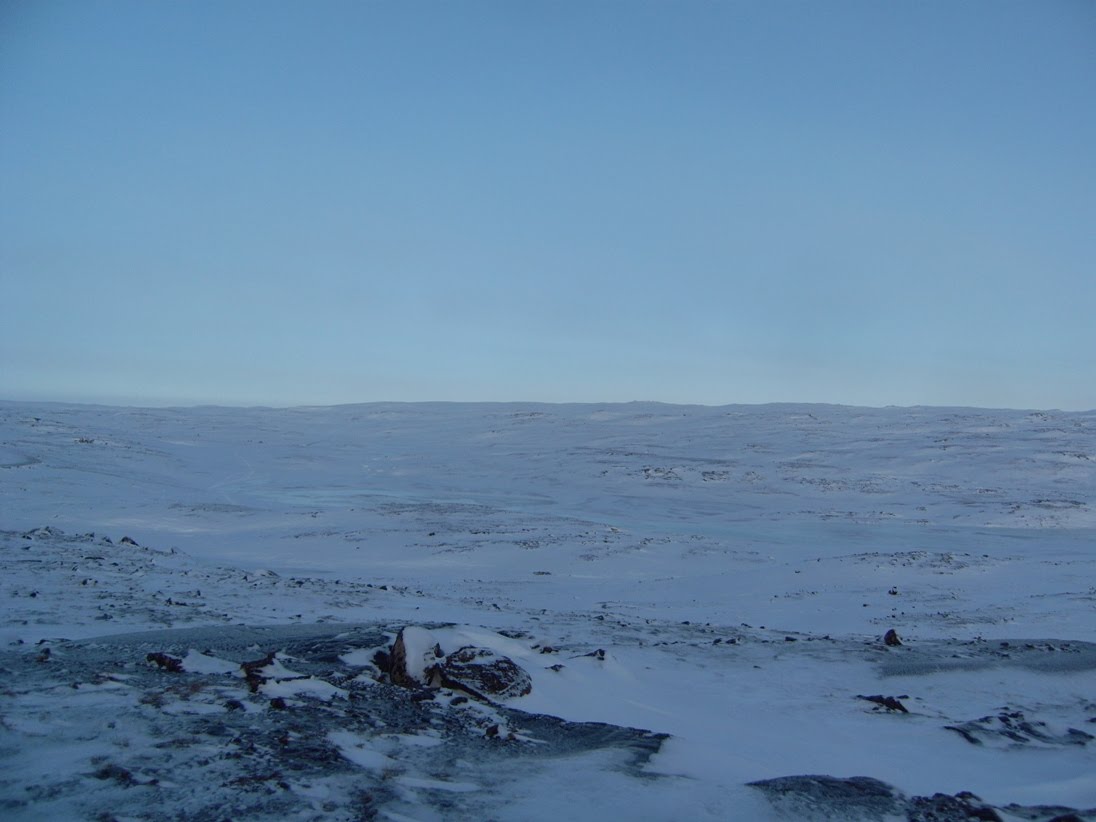
Frozen landscape...


Sleepy, little frozen town...

Think warm thoughts for me!

Tuesday, January 25, 2011

The Homeliest Creature

Recently I have attended meetings on walrus, and my god, what a homely creature! There haven’t actually been any walruses in attendance at these meetings, but there have been plenty of pictures. They are all whiskers and eyeballs!

See, I told you! (P.S. Again, none of these pictures are mine - I haven't had the pleasure of seeing one of these guys in the wild - so hopefully my blog site won't get shut down!)


I have learned some interesting things about them though. The walrus is a relatively long-lived, social animal and is considered a keystone species in Arctic marine ecosystems. Adult male walrus can weigh up to 3,700 lb - females weigh about two-thirds as much – making them the second largest pinniped (fin-footed mammals – seals and walrus), after elephant seals. Their blubber layer is up to 15 cm (5.9 in) thick!

They live primarily in shallow oceanic shelf habitat, spending a significant proportion of their lives on sea ice in pursuit of their preferred diet of molluscs, especially clams. They forage on the bottom using their sensitive whiskers. They suck meat from clams by sealing their powerful lips around them. The walrus has an air sac under its throat which acts like a floatation bubble and allows it to bob vertically in the water and sleep.

Gestation lasts 15 to 16 months and walrus make excellent mothers - they will defend their young fiercely. I have heard stories of mothers clutching their young close to their bodies and hiding them beneath them in the water when hunters approach. Calves weigh 100–170lb at birth and are able to swim immediately. The mothers nurse for over a year before weaning, but the young can spend up to 3 to 5 years with the mothers.


Look at those whiskers! They actually make earrings up here out of walrus whiskers and they are surprisingly nice!


The walrus has played a prominent role in the cultures of many indigenous Arctic peoples, who have hunted walrus for their meat, fat, skin, tusks and bone. Traditional hunters used all parts of the walrus. The meat, often preserved, is an important winter nutrition source; the flippers are fermented and stored as a delicacy until spring (I have also heard about fermented walrus head, also considered a delicacy); tusks and bone were historically used for tools as well as material for handicrafts; the oil was rendered for warmth and light; the tough hide made rope and house and boat coverings; the intestines and gut linings made waterproof parkas, etc. While some of these uses have faded with access to alternative technologies, walrus meat remains an important part of local diets, and tusk carving and engraving remain a vital art form.

In the 19th and early 20th centuries, the walrus was the object of heavy commercial exploitation for blubber and ivory and its numbers declined rapidly. The Atlantic Walrus was nearly eradicated by commercial harvest and has a much smaller population than the Pacific Walrus; today their population is probably below 20,000.

The males possess a large baculum up to 63 cm (25 in) in length, the largest of any land mammal both in absolute size and relative to body size. What’s a baculum, you ask? A baculum is a bone found in the penis of most mammals – I know right? I was very surprised the first time I heard about baculums during my undergrad. It is absent in humans – this shouldn’t come as a surprise - but present in other primates, including the closely-related chimpanzee.
Walrus baculum

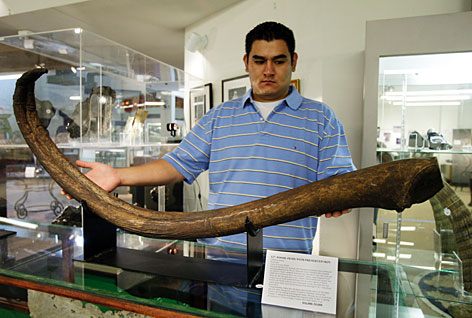
Oosik is a term used in Native Alaska cultures to describe the baculum of walruses, seals, sea lions, and polar bears. The oosik is a polished and sometimes carved baculum of these large northern carnivores, sold as souvenirs to tourists by Alaska Natives. In 2007 a 4.5-foot (1.4 m) long fossilized penis bone from an extinct species of walrus, believed by the seller to be the largest in existence, was sold for $8,000. I was reviewing hunt plans for walrus and was surprised to see the baculum as one of the trophies for sport hunters to keep, along with the tusks and hides. Sport hunters pay a lot of money to come to Nunavut to hunt walrus; the communities keep the meat.

Giant fossilized walrus baculum... how big was the walrus!!!

One thing is for sure though! Walrus babies are the cutest!!!

Tuesday, January 18, 2011

More about northern de-lights!

Happy New Year one and all! Hope you enjoyed the holidays. I was home in Nova Scotia for two and a half weeks, and I certainly enjoyed every moment of it. It wasn’t easy to leave, but I’ve been back for over a week and already I feel myself settling back into my old routine.

The weather here was been absolutely beautiful, other than some overcast skies over the weekend. Despite the -20 temperatures, the weather continues to be unseasonably mild! It should be between -30 and -40 pretty consistently from mid-January to mid-February. I personally am prepared to accept that this is a result of the effects of La Nina, with a touch of global climate change, and keep things as they are! Clear and sunny skies during the day make for fantastic aurora borealis (northern lights) viewing when the sun goes down, which is shortly after 3pm these days. That means I get to enjoy the show on my walk home from work at 5pm. I haven’t done much this week other than catch up at work, so I thought we could talk a little bit about auroras.

You can often find me standing on the side of the road as cars dash by with my eyes on the sky (I discovered some time ago that it is not wise to look up while attempting to walk). At these moments I feel very child-like, marvelling over some natural phenomenon for the first time. I am usually too mesmerized and awe-inspired to think too much about what they are and why they occur – they are almost too beautiful to be explained - but alas the scientist in me eventually takes over and I like nothing more than a good science lesson…

So what are they? The bright dancing lights of the aurora are actually the result of collisions between gaseous particles in the Earth's atmosphere with charged particles released from the sun's atmosphere. I said what? You may have to read this sentence a couple of times to really take in what it says.

The Earth is constantly immersed in the solar wind, a continuous flow of free electrons and positive ions emitted by the Sun - a result of the million-degree heat of the Sun's outermost layer, the corona. Blown towards the earth by the solar wind, these charged particles are largely deflected by the earth's magnetic field; however, the earth's magnetic field is weaker at the poles so that some particles enter the earth's atmosphere and collide with gas particles. Collisions between these ions and atmospheric atoms and molecules cause energy releases in the form of the dancing lights of the auroras. Seen from space, these fiery curtains form a thin ring around the earth’s pole (see pictures below... so awesome).

Variations in the colour of auroras are due to the type of gas particles involved in the collisions. The most common aurora color, a pale yellowish-green (you have seen these in some of my pictures, by far the most common I have seen), is produced by oxygen molecules about 100km above the earth’s surface. Rare, all-red auroras are produced by high-altitude oxygen at heights up to 500km, whereas nitrogen produces blue or purplish-red aurora. The lights of the aurora extend from about 80km above the earth to as high as 640km and typically appear as a diffuse glow or as “curtains” that extend in an east-west direction. Each curtain consists of many parallel rays lined up with the direction of the magnetic field lines. At some times they form "quiet arcs", while at others they are "active auroras" and evolve and change constantly.

Auroras are seen in both the northern and southern hemispheres. 'Aurora borealis', the lights of the northern hemisphere, means 'dawn of the north'; 'Aurora australis' means 'dawn of the south'. Interestingly, scientists (oh, those scientists!) have learned that in most instances northern and southern auroras are mirror-like images of each other that occur together with similar shapes and colors, though in the south the lights are not often seen as they are concentrated in a ring around Antarctica and the southern Indian Ocean.

In Roman myths, Aurora was the goddess of the dawn. Many cultural groups have legends about the lights. In medieval times, the occurrences of aurora displays were seen as harbingers of war or famine. The Maori of New Zealand shared a belief with many northern people of Europe and North America that the lights were reflections from torches or campfires. The Menominee Indians of Wisconsin believed that the lights indicated the location of manabai'wok (giants) who were the spirits of great hunters and fishermen. The Inuit of Alaska believed that the lights were the spirits of the animals they hunted: the seals, salmon, deer and beluga whales. Other aboriginal peoples believed that the lights were the spirits of their people.

The best time of year to watch for aurora displays is in the spring and fall (I didn’t see any until well into September), but winter in the north is also generally a good season because of the long periods of darkness and the frequency of clear nights. Researchers have also discovered that aurora activity is cyclic, peaking roughly every 11 years, with the next peak period in 2013. Not sure that I will still be here then...

They are occasionally seen in temperate latitudes, when a magnetic storm temporarily expands the aurora oval. Large magnetic storms are most common during the peak of the eleven-year sunspot cycle or during the three years after that peak. The auroras that resulted from the "great geomagnetic storm" on both August 28 and September 2, 1859 are thought the most spectacular in recent recorded history. The aurora event which occurred on September 2, 1859 produced aurora so widespread and extraordinarily brilliant that they were seen and reported in published scientific measurements, ships' logs and newspapers throughout the United States, Europe, Japan and Australia.

Check out these amazing pictures! I didn’t take these pictures, by the way... in case there was any confusion...

Aurora borealis


Aurora australis

This one is on Jupiter!

This one is mine though...

Wednesday, December 15, 2010

All work and no play makes Lesley a dull girl…

Well, winter has definitely descended upon this sleepy little town. Temperatures finally dropped to the -30° that I kept hearing about, but it’s not so bad. With the cold come clear skies and beautiful sunrises and sunsets (that take place only five hours apart!). I stayed home from work today (haven’t been feel up to par this week) and this is the sunrise that I woke up to… just spectacular!


A little later in the day I went with Siu-Ling down to the dog yard to feed the dogs. They were all in good spirits today as usual. I really enjoyed seeing momma Gigi playing with her two pups. It’s really interesting because she plays with them, but at the same time there is a level of seriousness to her play. She is teaching them their place in the team, particularly picking on Bo, the more dominant of the two pups. He really needs to be put in his place… it’ll be good for him.


As you can see from the pictures we have lots of snow now! About a week ago we got a couple of days of snow and then temperatures dropped even further. Now Iqaluit is buried in snow and reminds me more of the town I first met. It was in early May that I was flown up here for my interview and there was a similar amount of snow on the ground, frozen windswept landscapes and skidoo tracks criss-crossing here and there. Everything was so unfamiliar then. It gives me a bit of a tingly feeling thinking about my first impressions back then and everything that has happened since…


I must say I don’t recall seeing skidoos driving around in traffic back then! But here they are…


On the weekend I rushed into Northmart just before closing time, only to find myself immersed in a crowd of anxious people in the baked goods department all looking up. I looked up to find myself below a net of balloons which I overheard someone say contained coupons for free stuff. That sounds like fun! Then I overheard someone else say that last year teeth were lost and blood was spilled over the same challenge, so I quickly got myself out of there. Yes, this may have been the most happening thing taking place in Iqaluit on a Saturday night… and no, I didn’t even see a drop of blood!


This blog entry is kind of lame! But so was my weekend… I’ll try and be more exciting next time :)